Wall Washing vs Wall Grazing: Same Wall, Two Intentions
Wall Washing vs Wall Grazing: Same Wall, Two Intentions
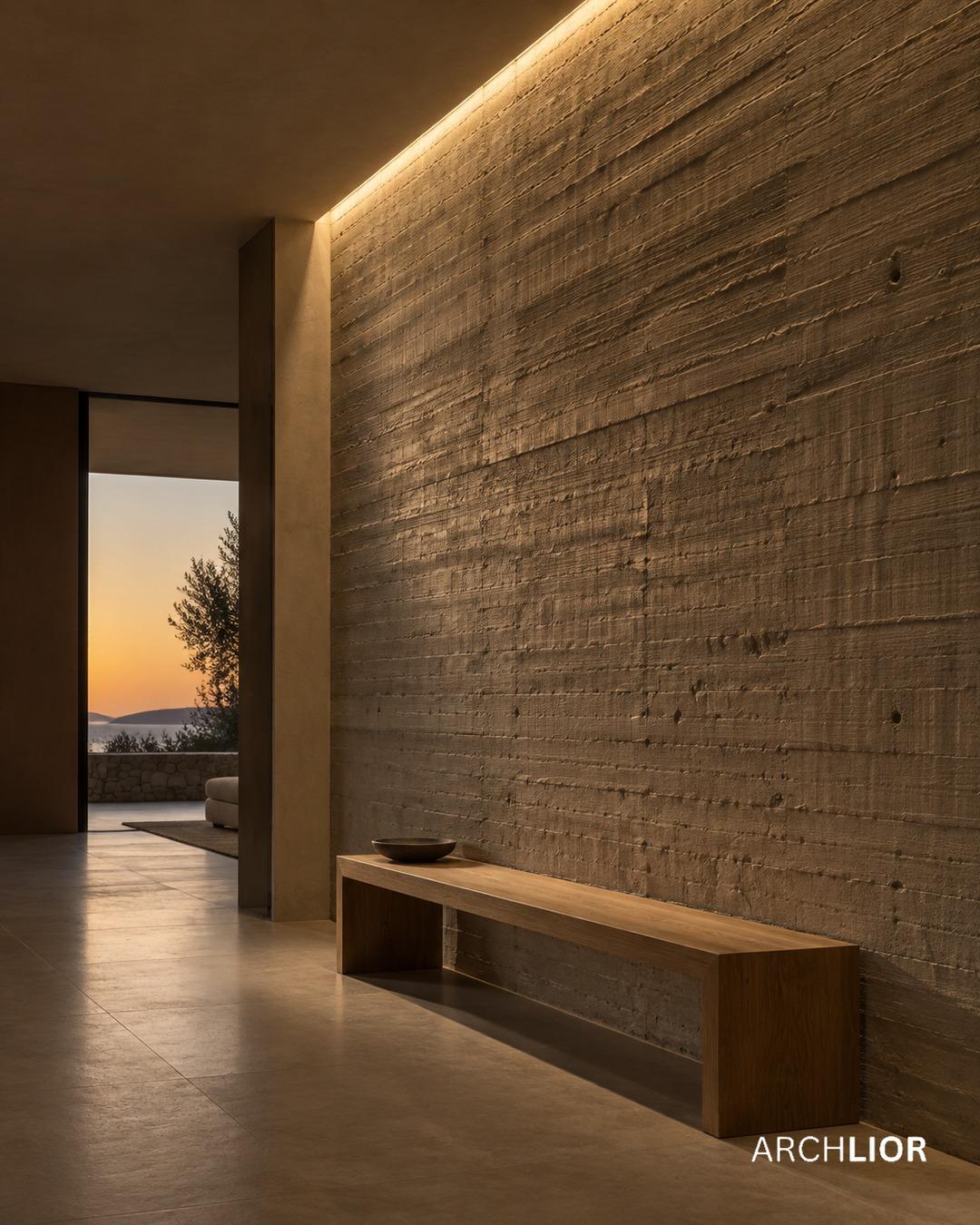
Imagine a textured stone wall in a hotel lobby. Light skimming close to its face reveals ridges and joints through shadow. A more even wash can make the same wall read as a calmer background.
That is the useful distinction: wall washing aims for relatively uniform vertical illumination; wall grazing aims to reveal texture with light at a shallow angle. Distance matters, but so do the optic, aiming, spacing and surface. Moving any ordinary fitting farther from a wall does not automatically turn it into a wall washer.
What Wall Washing Does
A dedicated wall-wash distribution is designed to spread light over a vertical surface. On suitable walls, it can create a comparatively even impression rather than a series of bright pools.
Illuminated vertical surfaces can make a room appear brighter and more spacious. The effect depends on the wall's reflectance, the rest of the room and the observer's view. A dark finish will not behave like pale plaster under the same incident light.
Washing can reduce the prominence of small surface irregularities compared with grazing, but it cannot guarantee that defects or shadows disappear. Test the actual finish before treating lighting as a remedy for poor workmanship.
What Wall Grazing Does
Grazing brings light close to the surface so it travels at a shallow angle. Projections cast shadows that can emphasise relief in brick, stone, ribbed timber or fluted plaster.
This can be a deliberate design choice when texture is the feature. It can also reveal unwanted joints, waviness and repairs. A sample panel under the intended light is more informative than a catalogue image of a different material.
Grazing is not automatically better for every textured wall. Some projects need a quiet backdrop; others need the material to stand out. Choose the effect first.
Placement: Use the Product's Guidance
For its lens wallwashers, ERCO gives a starting wall setback of approximately one third of the room height, with spacing up to 1.3 times that setback for suitable products. These are manufacturer-specific planning guides, not universal installation rules.
For a 2.4 m wall, one third is 0.8 m. That is a useful first sketch for a compatible wallwasher, not proof that an arbitrary downlight at 0.8 m will light the wall evenly.
Special grazing optics may operate much closer. ERCO illustrates grazing arrangements at about 0.1 m from the wall for particular products. Other optics and mounting arrangements have different requirements. There is no universal 30 cm boundary separating washing from grazing.
Use the selected product's spacing tables and photometric data. Check the top and bottom of the wall as well as horizontal overlap. Furniture, beams and recesses can interrupt the light.
Two Illustrative Design Decisions
A smooth wall behind reception. The aim is an even, quiet background. Start with a dedicated wallwasher and the manufacturer's recommended layout. Test for bright bands, scallops and glare from the entrance and seating positions.
A stone feature wall beside a stair. The aim is to reveal relief. Test a grazing optic on the actual stone. Inspect the wall from above and below, including the view towards the source. The most dramatic photograph is not necessarily the most comfortable everyday view.
These are hypothetical examples, not reports of completed Archlior installations.
Art, Exteriors and Glare
A wall wash may be sufficient for some artwork displays; others need a separate accent or different distribution. The choice depends on the artwork, desired contrast, reflections and any conservation requirements. An additional spotlight is not always necessary.
Outside, specify equipment suitable for the actual exposure, location and applicable rules. Moisture protection alone does not settle electrical safety, corrosion resistance, glare or spill light. Check the complete installation with an appropriate professional.
For both techniques, inspect the source from realistic viewing positions. Floor-mounted uplights can be especially conspicuous to someone looking down, while high-mounted fittings can be visible along a corridor. Shielding and placement need to be assessed together.
Frequently Asked Questions
Can an ordinary downlight wash a wall? It may contribute vertical light, but a regular downlight layout can produce scallops rather than a uniform wash. Check the actual distribution instead of assuming a wide beam is enough.
Is grazing only from above? No. It can be directed from above, below or the side. The resulting shadows and views of the source differ.
Which uses less energy? Neither technique is inherently lower-energy. Compare input power, quantity, controls, operating hours and the light needed for the intended effect. Equal lumens do not establish equal electricity consumption.
Will washing make a small room bigger? It may make the room appear more spacious, but it does not change its dimensions or guarantee a particular perceptual result.
Browse the Archlior product catalogue for ideas. Obtain the selected manufacturer's current photometric files and layout guidance before specifying.
Sources
- ERCO: arranging luminaires, for wallwasher setback and spacing guidance.
- ERCO: illuminating walls in reception areas, for washing, grazing, perception and product-dependent arrangements.
Disclaimer
This article is for general information, not project-specific design, engineering, electrical-safety or medical advice. Examples are illustrative and do not guarantee performance, compliance or health outcomes. Verify current specifications and applicable requirements with manufacturers and qualified professionals before purchase or installation. To the extent permitted by law, Archlior accepts no liability for loss arising from reliance on this content. Nothing here excludes liability that cannot lawfully be excluded.