Lighting a Child's Room: Sleep First, Play Second
Lighting a Child's Room: Sleep First, Play Second
A child's bedroom may be a play space, a homework corner and a place to sleep. Those uses call for different lighting conditions. Instead of choosing one bright setting for everything, plan how the light can change through the day and evening.
There is no lamp, colour temperature or lighting scene that guarantees sleep. A useful scheme supports comfortable activities and a calm bedtime routine while keeping safety first.
What the Research Actually Shows
In a 2014 study, Higuchi and colleagues compared evening light-induced melatonin suppression in primary-school children and adults. Under the study's 580 lux condition, suppression was greater in the analysed child group. The final comparison was small: five children and six adults, after exclusions. In a separate home-light condition, suppression was statistically significant in the analysed children but not in the adults.
This supports taking children's evening light exposure seriously. It does not establish a safe brightness threshold for every child, show that adults are unaffected by ordinary room light, or prove that a particular bulb will improve sleep. Melatonin suppression is a physiological response, not a direct measurement of how well a child will sleep.
For practical routines, Nemours KidsHealth recommends limiting bright lights at night, using dim, warm-coloured evening lighting and keeping the bedroom dark for sleep.
Four Uses, Four Lighting Decisions
Daytime play. Make the floor, storage and activity areas easy to see. Use daylight where practical, with control of glare and direct sun, and add electric light when needed. Inspect the room from the child's height as well as your own.
Homework. Provide light on the actual desk surface, not just in the centre of the room. An adjustable task lamp can help avoid shadows from the child's hand and body. Check reflections on screens and pages. The suitable illuminance depends on the task and user; this article does not prescribe a universal lux target for children's homework.
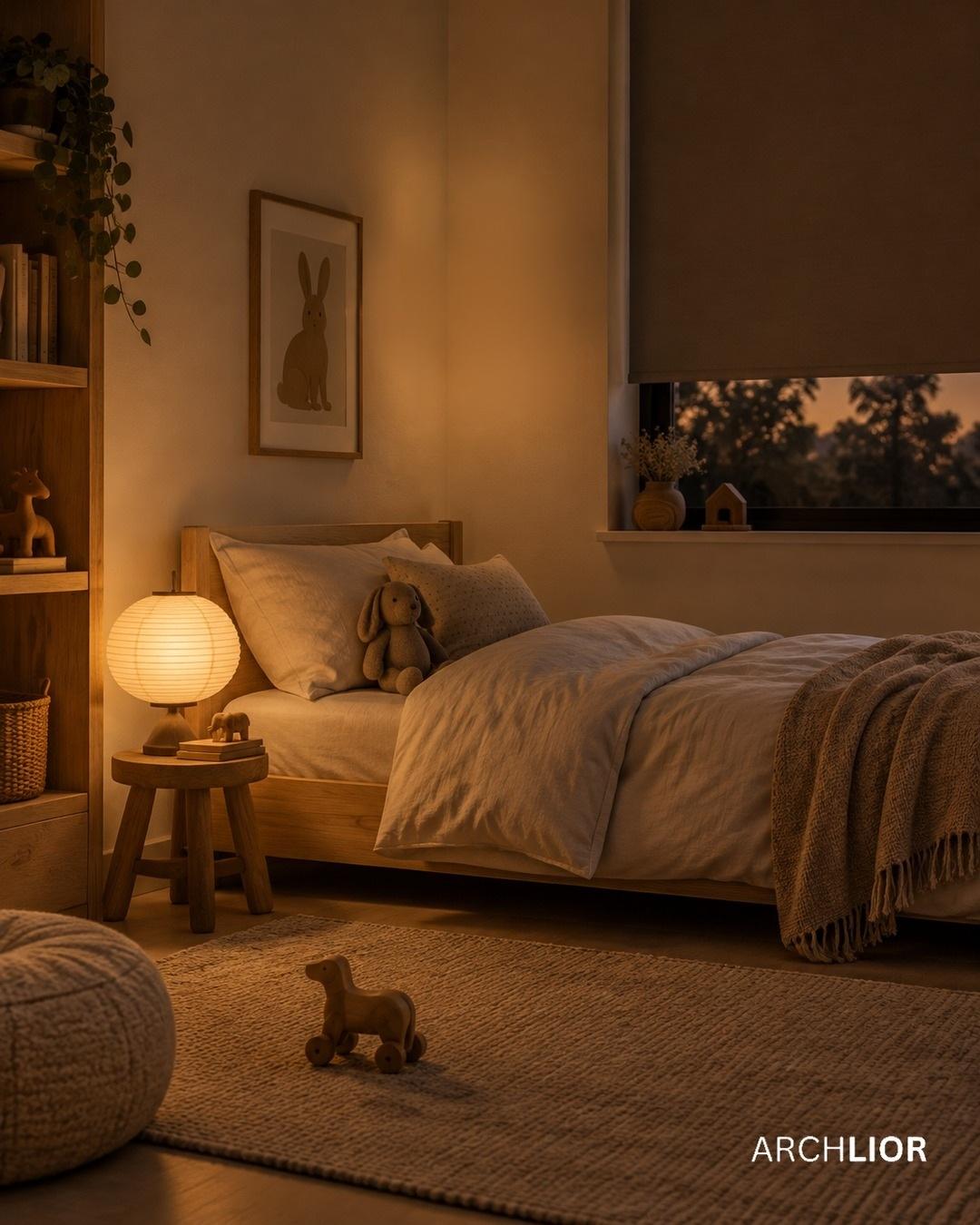
Wind-down. Make it easy to reduce the overall light level for a quiet bedtime routine, while leaving enough light for reading and safe movement. A shaded reading lamp or controlled wall light may be more useful than a bright ceiling source.
Sleep and night-time movement. Keep the room as dark as safely practical. If a night light is needed for reassurance or navigation, choose a low-output source, minimise light reaching the eyes and use it only as needed. Position it to avoid trip hazards and inaccessible or unsafe controls.
These are design starting points. The child's age, visual needs, mobility and health can change the appropriate arrangement.
Warm Light Is Not a Sleep Guarantee
A warm appearance can be useful for an evening setting, but the Kelvin number is not a complete measure of biological effect. Light level at the eyes, spectrum, timing and duration all matter.
The CIE's 2024 position statement warns against labelling light "healthy" or "unhealthy" using correlated colour temperature alone. It also notes that adult light-exposure recommendations are not established as applicable to children.
Do not treat 2700 K as a medical cut-off or assume that a very bright warm lamp is harmless near bedtime. Reducing exposure matters as well as choosing a comfortable appearance.
Safety Before Atmosphere
- Keep cords out of reach. Consider leads for lamps, monitors and blinds, especially near cots and beds. Cordless window coverings avoid a cord hazard when controlling daylight.
- Check stability. Portable lamps must not be easy to pull over or reach by climbing. Reassess the room as the child becomes mobile.
- Do not assume LED means cool or safe to touch. LEDs generate heat and require thermal management. Accessible surfaces, the driver and the fitting need to be assessed using the manufacturer's instructions and warnings.
- Have fixed fittings installed properly. A qualified installer should select fixings appropriate to the luminaire's weight and the actual structure. Do not rely on a generic rule about plasterboard or joists.
- Check electrical and control compatibility. Not all lamps are dimmable, and not all dimmers work with every driver. Use products suitable for the installation and follow local requirements.
This is not a complete childproofing or infant safe-sleep checklist. Lighting choices must not compromise the separate requirements for a safe sleep environment.
Frequently Asked Questions
Does a child's room need a night light? Not necessarily. If one helps with reassurance or safe movement, keep it low and avoid unnecessary exposure. Individual needs differ.
Will blackout blinds solve sleep difficulties? They can reduce unwanted light, but sleep difficulties have many causes. Choose safe window coverings and seek medical advice for persistent concerns.
Can a smart bulb help? It may make a lower evening setting easier to use. Check compatibility, reliable manual control and safe installation. Automation is not a substitute for supervision or a bedtime routine.
Browse the Archlior product catalogue for inspiration. Confirm product safety, dimming and suitability with the manufacturer and installer.
Sources
- Higuchi et al. (2014): Influence of light at night on melatonin suppression in children, primary research with the limitations described above.
- CIE (2024): Recommending Proper Light at the Proper Time, third edition.
- Nemours KidsHealth: sleep hygiene.
- American Academy of Pediatrics: home safety, for cord and tip-over precautions.
- US Department of Energy: thermal management of white LEDs, for the fact that LEDs generate heat, not a touch-temperature rating for any specific product.
Disclaimer
This article is for general information, not project-specific design, engineering, electrical-safety or medical advice. Examples are illustrative and do not guarantee performance, compliance or health outcomes. Verify current specifications and applicable requirements with manufacturers and qualified professionals before purchase or installation. To the extent permitted by law, Archlior accepts no liability for loss arising from reliance on this content. Nothing here excludes liability that cannot lawfully be excluded.